Forex vs. Stock Copy Trading: Which Arena Is Right for You?

Copy Trading Risk Management: Your Ultimate Guide to Trading Safely
26th February 2026
Ready to launch your copy trading adventure but feel stuck at a cosmic crossroads? On one path lies the lightning-fast, 24/7 universe of currencies; on the other, the familiar terrain of company stocks. It’s a monumental choice, and the jargon alone-leverage, spreads, volatility-can feel like an alien language. If you’re wondering whether the high-octane world of forex copy trading is your perfect match or if stocks are a safer bet, you’re not alone. This hesitation is the first boss level every new trader must face.
But what if you had a cheat code? Consider this guide your personal star map, designed to demystify the magic behind both arenas. We’ll break down the core differences, explore the unique strategies for each, and help you discover which financial playground truly matches your personality and risk tolerance. By the end, you’ll be ready to confidently choose your path and start your trading journey, avoiding the common black holes that trap so many beginners.
Key Takeaways
- Uncover the core difference: Forex trading thrives on high-speed volatility, while stock trading favors long-term strategic growth.
- Learn how the 24/5 nature and immense liquidity of the market make forex copy trading a dynamic arena for short-term opportunities.
- Discover why copying stock traders can be a powerful strategy for building a portfolio based on company growth and market stability.
- Identify your unique trader personality to find your perfect copy trading arena and align your strategy with your financial goals.
The First Quest: Understanding the Copy Trading Universe
Welcome, future trader! Your journey begins with a simple, yet powerful concept: copy trading. Imagine tapping into the mind of a seasoned market navigator, automatically mirroring their every move in your own account. It’s a modern approach to investing, and for those wanting a deeper historical context, understanding the copy trading universe from its origins is a great start. But before you take flight, you must choose your arena. The game changes dramatically depending on where you play. We’ll explore two primary battlegrounds: the high-octane world of Forex and the strategic landscape of Stocks. This isn’t about finding the ‘best’ arena-it’s about discovering which one is built for you.
What is the Core Mechanic?
So, how does this magic work? The process is surprisingly straightforward, putting sophisticated strategies within your reach. At its heart, copy trading operates on a few simple principles:
- You Choose a Leader: You browse through profiles of experienced traders, analyzing their performance, risk score, and strategy before selecting one to follow.
- Your Account Replicates: Once linked, your account automatically executes the same trades as your chosen leader in real-time, proportionally to the capital you’ve allocated.
- You Set the Rules: You remain the captain of your ship. You decide how much capital to invest and can set your own risk parameters, like a Stop Loss, to protect your funds.
Why the Market Matters
Choosing between Forex and stocks is like choosing between a speedboat and a cargo ship. Both can cross the ocean, but they offer vastly different journeys. The fast-paced currency pairs in Forex demand quick reflexes and short-term strategies, making it a thrilling environment. This is where the dynamism of forex copy trading truly shines, allowing you to mirror experts who thrive on volatility.
In contrast, the stock market is often a game of patience and long-term vision, focusing on company growth. The strategies that lead to victory in one arena could spell disaster in the other. Your choice directly impacts potential returns, risk levels, and the overall rhythm of your trading adventure, which is why understanding the nuances between forex copy trading and stock copying is your first critical mission.
Enter the Forex Arena: High Speed and High Stakes
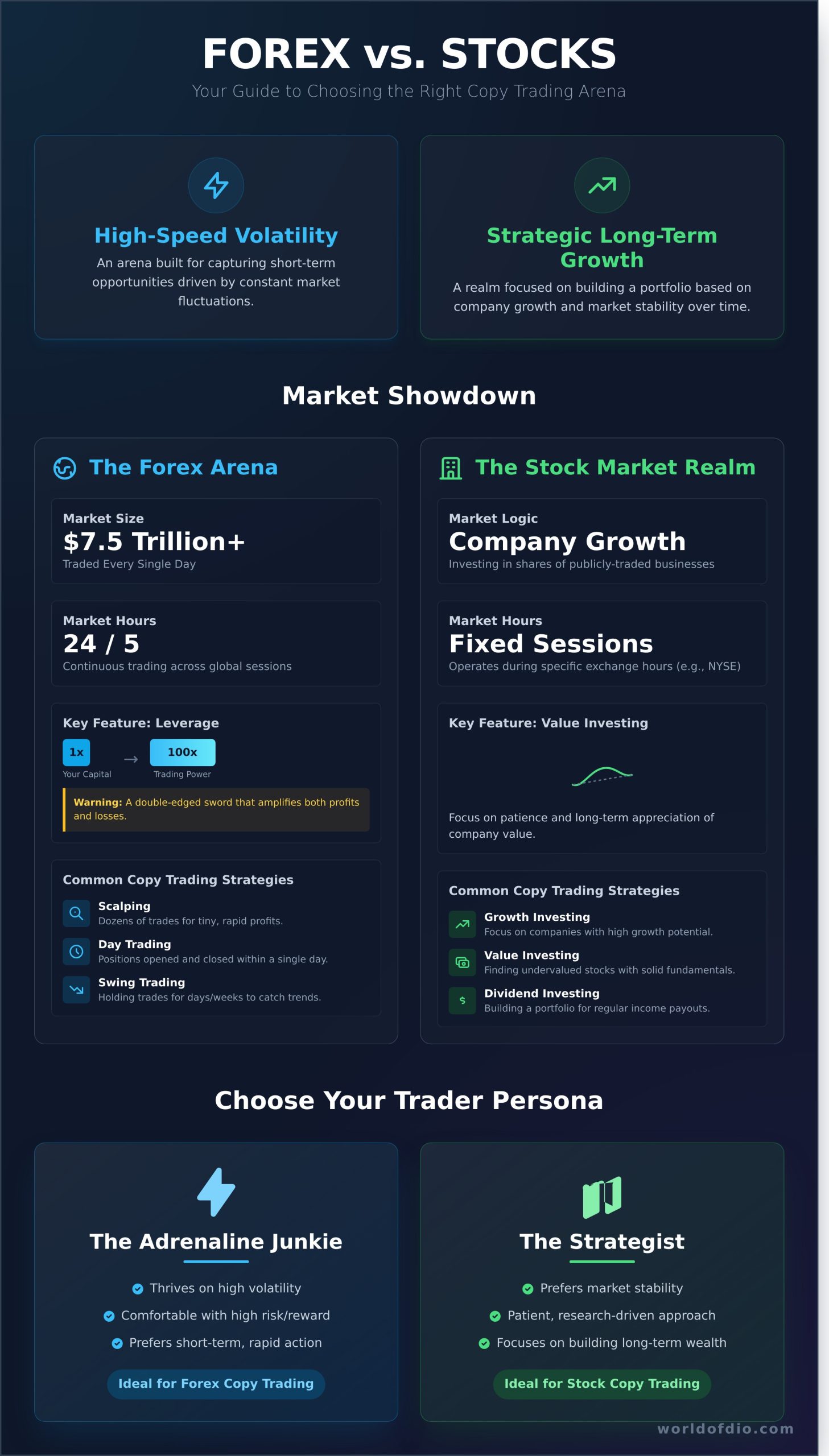
Step into the world’s largest and most liquid financial market-a decentralized, digital battleground where over $7.5 trillion changes hands every single day. Unlike the stock market’s structured exchanges, Forex is a relentless 24/5 arena where currencies like the EUR, USD, and JPY are traded in pairs. Success here isn’t about long-term corporate value; it’s a high-octane game of capturing short-term price movements, often measured in tiny increments called “pips.” This environment is a magnet for traders who thrive on volatility and split-second decisions.
The Power of Leverage: A Double-Edged Sword
Leverage is the turbo-boost of Forex trading, allowing you to control a massive position with a fraction of the capital. For example, with 100:1 leverage, just $1,000 in your account can command a $100,000 position, dramatically amplifying profits from even the smallest price change. But here’s the crucial warning: leverage is a double-edged sword. It magnifies losses just as powerfully as gains, and the allure of high returns can be intoxicating. Research from INFORMS highlights that the social dynamics of copy trading often increases the risk-taking behavior of participants, making risk management absolutely critical.
Around-the-Clock Action
The Forex market never truly sleeps. It operates 24 hours a day, five days a week, rolling through major financial centers from Tokyo to London to New York. This constant action creates a continuous stream of trading opportunities, unbound by a single time zone. For those using forex copy trading platforms, this is a game-changer. Your chosen expert in Singapore could be capitalizing on market movements while you’re sound asleep in Chicago, making your capital work for you around the clock.
Common Forex Copy Trading Strategies
The fast-paced nature of Forex has given rise to several distinct strategies. Understanding them is key to picking the right trader to follow:
- Scalping: The ultimate short-term game. Scalpers execute dozens or even hundreds of trades a day, aiming to skim tiny profits from minimal price changes.
- Day Trading: Less frantic than scalping, day traders open and close all their positions within a single trading day, avoiding overnight risk and fees.
- Swing Trading: These traders hold positions for several days or weeks, aiming to capture larger market “swings” or emerging trends.
The Stock Market Realm: Strategy and Long-Term Growth
Shifting gears from the high-speed world of currency pairs, we enter the foundational realm of stocks. Here, trading transforms from reacting to market fluctuations into investing in the future of actual companies. It’s a landscape built for patient visionaries, where long-term growth and strategic ownership take center stage over the rapid-fire trades often seen in forex copy trading.
Ownership and Fundamentals
When you buy a stock, you’re acquiring a literal share of ownership in a business. It’s your ticket to participating in the success of innovators like Apple or Tesla. Many companies even share their profits directly with you through dividends, creating a potential stream of passive income. Success here is less about fleeting chart patterns and more about deep-dive analysis-exploring company health, earnings reports, and industry trends to uncover hidden potential.
Set Hours, Calculated Moves
Unlike the 24/5 forex market, the stock market operates on a strict schedule. Major exchanges like the New York Stock Exchange (NYSE) have defined opening and closing bells, creating a predictable daily rhythm. This structure encourages calculated moves rather than constant screen-watching. Big price shifts often align with scheduled events like quarterly earnings reports or major corporate news. This structured environment also means navigating a well-defined legal landscape, which is why U.S. authorities are exploring the regulatory concerns for copy trading to ensure investor protection within this established framework.
Typical Stock Copy Trading Approaches
The strategies you’ll find in stock copy trading often mirror long-term investment philosophies. Instead of high-frequency scalping, the focus is on building wealth over time. Popular approaches you can copy include:
- Value Investing: Following traders who hunt for solid, undervalued companies poised for a comeback.
- Growth Investing: Mirroring experts who focus on innovative companies with explosive growth potential.
- Position Trading: Adopting strategies that hold stocks for weeks or months to capitalize on major market trends.
Feeling overwhelmed by the different approaches? Let World Of Dio be your guide.
Head-to-Head: Forex vs. Stocks Showdown
Now, let’s put the two arenas side-by-side for a direct comparison. The world of currency pairs and the universe of company shares operate on different rhythms, each offering unique opportunities and challenges. Understanding these core differences is the key to unlocking a strategy that resonates with your personal goals and lifestyle.
To make it crystal clear, we’ll break down the most critical factors that impact you as a copy trader. Think of this as your strategic briefing before choosing your champion.
Volatility & Risk Profile
The temperament of each market is vastly different. The forex market is a sea of constant, small fluctuations, driven by global economics and high liquidity. Stocks, on the other hand, can remain stable for long periods before a single news event-like an earnings report or a product launch-causes a sudden, sharp movement.
- Forex Risk: Success here is often about mastering leverage. Since price moves are small, leverage amplifies them, but it also amplifies risk. A copied trader’s skill in managing this is paramount.
- Stock Risk: This is tied more to the fundamental health of a company or the entire market. A single bad quarter or a market crash can erase value quickly, making diversification a key defensive play.
Trading Hours & Accessibility
Your daily schedule plays a huge role in which market is a better fit. The forex market never truly sleeps, operating 24 hours a day, five days a week across different global sessions. This offers incredible flexibility. Stock markets are traditionalists, sticking to standard business hours for their specific country, such as 9:30 AM to 4:00 PM EST for Wall Street.
For those with busy or unconventional schedules, the accessibility of forex copy trading is a massive advantage, allowing you to monitor strategies and performance whenever it suits you.
Costs: Spreads vs. Commissions
How you pay for trades is another crucial distinction. In forex, the primary cost is the spread-the tiny difference between the buy and sell price of a currency pair. It’s built directly into your trade. While stock platforms also have spreads, they frequently add a separate commission fee for each trade you execute.
When you’re engaged in high-frequency forex copy trading, those small spreads can accumulate. Conversely, commission-based costs on stock platforms can make it expensive to copy a strategy that involves many small, frequent trades.
Choose Your Character: Who Are You as a Trader?
The epic clash between the Forex and Stock markets isn’t about which is better-it’s about which is better for you. Your ideal trading arena is a direct reflection of your personality, your appetite for risk, and your ultimate financial quest. There is no single right answer, only the path that aligns with your unique character. This moment of self-reflection is the most critical step in your entire adventure. Let’s explore the profiles to help you find your perfect match.
You Might Be a Forex Trader If…
You are the adrenaline-seeker, the strategist who thrives in a world of constant motion. The 24/5 global currency market is your playground, offering endless opportunities. If this sounds like you, exploring the world of forex copy trading might be a perfect way to start, allowing you to learn from seasoned veterans in a fast-paced environment.
- You crave high-speed action and are comfortable navigating higher risk for higher potential rewards.
- You want to start with smaller capital, using leverage as a powerful tool to amplify your positions.
- You value the freedom to trade whenever inspiration strikes, day or night.
- You possess the discipline to manage risk with precision, using tools like stop-loss orders without hesitation.
You Might Be a Stock Trader If…
You are the patient architect, the visionary who builds lasting value brick by brick. You’re fascinated by the stories behind companies and believe in the power of long-term growth. You see the market not as a battlefield, but as a garden to be cultivated over time.
- You prefer a slower, more deliberate approach to building your wealth.
- You enjoy deep-diving into company fundamentals, earnings reports, and industry trends.
- You have a lower tolerance for risk and are cautious about using significant leverage.
- Your goal is to construct a diversified portfolio that you can proudly hold for years, even decades.
Your Next Step in the Adventure
Whether you choose the rapid currents of forex or the steady growth of stocks, knowledge is your greatest weapon. The right platform is more than just a tool; it’s your training ground, your guide, and your community. At World of Dio, we’ve designed an ecosystem to help you level up, no matter which arena you enter. Your journey to market mastery begins now.
Start your training and master the markets with us.
Choose Your Arena, Begin Your Quest
The battle between the fast-paced forex arena and the strategic stock market realm is ultimately decided by one hero: you. Your trading journey is a personal quest, defined by your appetite for risk and your vision for the future. Are you a high-speed warrior thriving on the 24/7 volatility of currency pairs, or a patient strategist building a long-term empire with blue-chip stocks? Whether the high-leverage thrill of forex copy trading calls to you or you prefer the steady climb of the stock market, the right path is the one that aligns with your unique character.
But no adventurer succeeds alone. The greatest quests require allies, mentors, and the right tools. At World of Dio, you’re not just starting an account; you’re joining a vibrant guild. Access a community of fellow adventurers to share strategies, follow expert traders on their journey to see how the masters navigate the markets, and unlock powerful training chapters to level up your skills from novice to hero.
Begin your adventure and join the World of Dio today!
Your financial destiny awaits.
Frequently Asked Questions About Copy Trading
Is Forex or stock copy trading better for a complete beginner?
Your trading adventure starts here! For many beginners, Forex offers a more accessible entry point due to lower capital requirements and a 24/5 market schedule, providing amazing flexibility. However, stock copy trading involves familiar company names like Apple or Tesla, which can make market movements feel more intuitive. The best choice is an exciting discovery that depends on your personal comfort zone and learning style.
Can I copy trade both Forex and stocks on the same platform?
Absolutely! The future of trading is all about integration. Many innovative platforms now function as powerful multi-asset hubs, allowing you to copy both Forex and stock traders from a single, streamlined account. This unlocks incredible potential for diversification, empowering you to build a dynamic portfolio that spans global markets. It’s the freedom to explore and grow without limits.
How much money do I need to start Forex copy trading vs. stock copy trading?
You can launch your journey with less than you might think! Getting started with forex copy trading is often possible with as little as $100 to $200, thanks to leverage and smaller trade sizes. For stock copy trading, you will typically need a slightly larger starting capital, often around $500 or more, to effectively mirror portfolios that include higher-priced shares. Both paths offer an accessible gateway to the markets.
What are the main risks I should be aware of in Forex copy trading?
Every great adventure involves navigating challenges. The primary risks in Forex are high volatility, which can cause sudden price swings, and the use of leverage, which magnifies both potential profits and losses. It’s also vital to remember that a trader’s past success doesn’t guarantee future returns. Smart risk management tools, like setting a stop-loss, are your essential gear for this journey.
Is it possible to lose more than my initial investment with leverage?
This is a critical question for any new explorer. While leverage amplifies risk, most modern, regulated brokers offer a powerful safety feature called Negative Balance Protection. This ensures your account balance cannot drop below zero, meaning you can never lose more money than you have deposited. Always confirm your chosen platform offers this protection for complete peace of mind as you trade.
How do I choose a reliable trader to copy in either market?
Think of it as choosing an expert guide for your expedition! Look beyond just the highest returns. Analyze a trader’s performance history for consistency over at least six months. Examine their platform-provided risk score-a lower score often signals a more stable approach. Also, review their maximum drawdown (their biggest loss) and the number of other investors copying them. A transparent and steady strategy is the key.